
In the early 20th century, scholars embarked on a race against time to document America’s disappearing folk traditions. This urgent mission, known as folklore fieldwork, involved traveling to remote communities to record songs, stories, and customs before industrialization and mass media erased them forever.
What is Folklore Fieldwork?
Folklore fieldwork is the systematic collection of traditional cultural expressions directly from their sources. Unlike studying literature in libraries, folklorists ventured into rural communities, mountain hollows, and urban neighborhoods to document music, tales, beliefs, and customs as they existed in living tradition. Collectors would transcribe songs by hand, interview elderly residents, and meticulously record the cultural context surrounding each tradition.
The Golden Age of Collection (1900s-1940s)
The peak era of American folklore collection stretched from the 1900s through the 1940s. This period coincided with rapid social change as railroads, automobiles, radio, and eventually television began penetrating previously isolated communities. Scholars recognized that centuries-old traditions passed down through oral transmission were vanishing as younger generations adopted modern entertainment and urban lifestyles.
The work intensified during the Great Depression when government programs like the Works Progress Administration funded extensive documentation projects. The Library of Congress Archive of American Folk Song, established in 1928, became a central repository for these efforts.
Why Collect Folk Traditions?
Several motivations drove this collecting frenzy. Academically, scholars wanted to understand how cultural traditions evolved and spread. Many believed that folk songs and stories contained traces of ancient European origins, offering insights into cultural migration patterns. Others were inspired by nationalist sentiment, seeking to define a distinctly American cultural identity separate from European influence.
There was also genuine urgency. Collectors witnessed firsthand how traditional singers and musicians were aging and dying without passing on their repertoires. Rural communities were being transformed by industrialization, military service, and education that emphasized “modern” over “backward” traditions. Many collectors felt they were salvaging the last remnants of authentic American culture.
The Collectors
Folklore fieldwork attracted a diverse group of dedicated scholars and enthusiasts. Cecil Sharp, an English collector, spent years in Appalachian communities documenting ballads he believed preserved medieval English traditions (see his collection). John Lomax became legendary for his work recording African American work songs, spirituals, and blues, often in prisons and labor camps where older traditions survived.
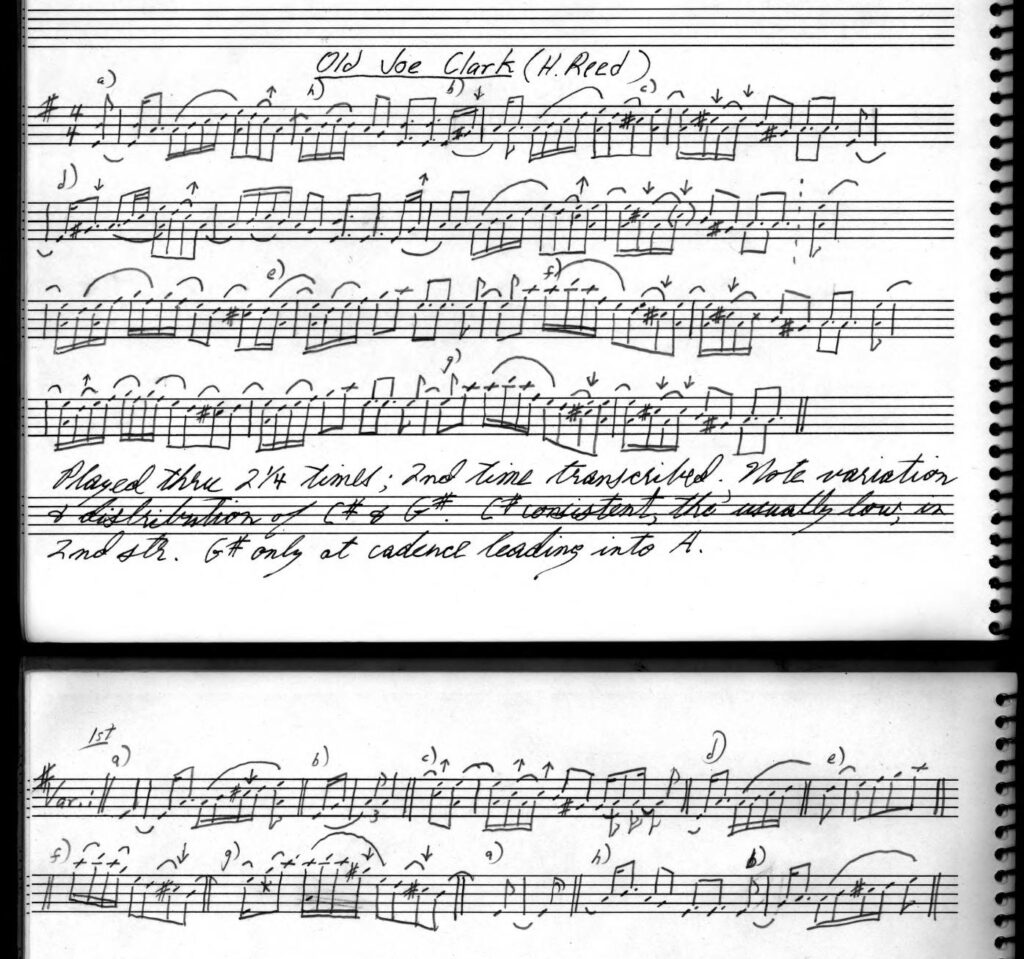
Academic institutions sent graduate students and professors into the field. E. C. Perrow, who documented “Old Joe Clark” in 1905, was among many university-based collectors who spent summers gathering material that would later become dissertations and scholarly articles. The Lomaxes (John and his son Alan) made collecting a family mission, using early recording equipment to capture not just lyrics but actual performances.

The Documentation Process
Fieldwork required patience and cultural sensitivity. Collectors often stayed with families for extended periods, building trust within communities suspicious of outsiders. They learned to distinguish between authentic traditional material and recently composed songs. Many faced challenges transcribing complex musical ornaments and unusual scales that didn’t fit standard notation.
The gap between collection and publication was often substantial. For example, Perrow’s 1905 collection wasn’t published until 1912, a typical delay as scholars organized their material, verified authenticity, and prepared scholarly presentations.
Modern Continuation of the Tradition
This systematic documentation created the foundation for our understanding of American traditional music, but the work didn’t end with those early pioneers. Contemporary efforts continue this vital mission through evolving methods and new technologies.
In the 1970s, Bruce Greene combined systematic documentation with traditional learning methods. Born in New York City, Greene moved to Kentucky as a young man and spent years living with and learning from aging fiddlers, many born in the 1880s. His 174 field recordings captured Kentucky fiddle traditions during a crucial period when rural musical culture was rapidly disappearing.
This personal learning model continues today through musicians like Canadian old-time fiddler Erynn Marshall, who studied extensively with legendary West Virginia fiddler Melvin Wine (1909-2003). Wine, a National Heritage Fellowship recipient, carried forward four generations of family fiddling tradition. Marshall documented Wine’s techniques in her book “Music in the Air Somewhere” while learning his distinctive bow work through countless hours of study. She now teaches these same tunes to new generations through workshops and online classes.
Modern technology has also revolutionized preservation efforts. The Milliner-Koken Collection of American Fiddle Tunes (2011) is an 888-page compilation of 1,404 transcribed tunes from 347 performers, most born before 1900. Unlike early collectors working alone with basic equipment, Milliner and Koken spent decades systematically transcribing from existing recordings, creating detailed indexes and biographical profiles.
The digital age has further transformed the field through projects like the Traditional Tune Archive, created by Andrew Kuntz and Valerio Pelliccioni. This semantic database organizes over 50,000 annotated tunes, allowing users to search by musical themes, trace tune families across cultures, and access both notation and audio files instantly.
These efforts demonstrate how folklore collection has evolved from individual scholars racing to preserve disappearing traditions to collaborative platforms making vast collections globally accessible. Without these dedicated fieldworkers—past and present—countless musical traditions would have vanished entirely.
Notes and future additions to be researched: Barbara Kunkle, a folklorist and field recorder, collected traditional music in the Appalachian region. Recorded J. P. Fraley’s Winds of Shiloh in August 1975. Finding aid for Kunkle Collection at Berea College. Fifty-six audio field recordings (1970s) of interviews and performances documenting the repertoire and styles of several Kentucky fiddlers, banjo players, and ballad singers mainly from the state’s northeastern region.